
In the Media
Historic Building Preservation: A Short Guide
Historic buildings of all sorts become indelible marks of their community over time. There is a certain irreplaceable aspect of the spirit of a place that is tied up in its historic buildings, monuments, and landmarks.
That’s probably why you landed here. You either own a historic building or are responsible for managing a property that has value that goes beyond its appraised price.
This short post will explore the main methods of historic building preservation and what they entail from a high level.
Why Should We Invest in Historic Building Preservation in the First Place?
There are many reasons we should consider historic building preservation to be a valuable practice.
One, and the most obvious reason, is to preserve the value of the structure itself. Many historic buildings are beautiful testaments to history, architecture and culture that are extremely economically valuable to their owners.
There is also the historical value to be considered. In a sense, historical buildings are inherently one-of-a-kind and cannot be replaced. If they are ever lost, they will be unfortunately gone forever.
Historical building preservation is also often one of the keys to economic health and development. The typical “Main Street” is the heart of most small communities, and the historic buildings there attract investors and support small businesses that survive on tourism and sightseeing.
Of course, these are only a few of the reasons that historical building preservation is a worthwhile investment, but they represent a good overview.
Authenticity, Integrity and Condition
With respect to historical building preservation, there are three key considerations that should be taken into account before investigating the best possible course of action. These are the integrity and condition of the property, along with its current level of authenticity.
There are two primary ways to define authenticity. One way to assess authenticity is by what portion of the original materials, workmanship and decoration are still present in the surviving structure; the other is based on an interpretation of the site or structure with respect to the culture that created it, even if little of the original workmanship remains.
Integrity and condition are a little more nuanced. A house that retains all of its original workmanship is considered to have high integrity, regardless of whether or not it is in a habitable state. Therefore, a house that has sustained a lot of damage, but which is in its original state, would be said to have high integrity (and thereby authenticity) but poor condition.
A house could also have a high degree of integrity (original structure, features and decoration) and excellent condition, too.
The Four Key Preservation Avenues
When exploring options for historical building preservation, there are four main options, or “treatments” as they are sometimes called. These are preservation itself (which may involve relocation) as well as rehabilitation, restoration and reconstruction.
● Historic Building Preservation and Relocation
Historical building preservation is chiefly the process of keeping an existing historical building in good condition so that no major renovations or repairs need to be made in order to keep it in serviceable shape.
At its most basic level, historical building preservation is the process of maintaining the original structure and in its existing form, in addition to the materials used. Therefore, when a building’s facade needs to be replaced, or the walls need to be painted, authentic preservation requires the use of the original materials and techniques applied in order to maintain integrity.
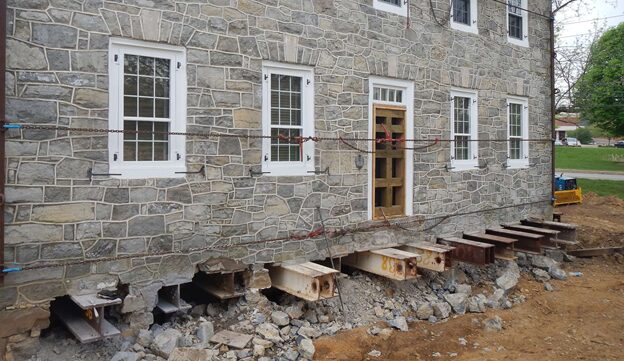
Sometimes it becomes necessary to physically relocate a historic building, and there are numerous reasons why this might be the case. Changing conditions might imperil the building in its current location; economic factors might do the same. Whatever the case, in order to preserve a historic building, sometimes relocation is the only option.
● Rehabilitation
Historic building rehabilitation includes a collection of practices that involve minimal alterations to a property or structure so as to improve its condition, with careful attention to the repairs, renovations and additions made to it, such that they honor its authenticity and integrity.
The concept of rehabilitation acknowledges that a building must sometimes be adjusted or altered, or that additions may need to be made, but there is a great deal of emphasis on techniques and materials used so as to preserve its historic fabric.
● Restoration
When a historic building has fallen into some or other state of disrepair, restoration may be the best reasonable course of action. Restoration, unlike preservation and rehabilitation, is a more invasive technique that may require considerable portions (or aspects) of the structure to be repaired.
However, this is not necessarily a bad thing, because sometimes restoration means bringing a building back to its original state. A building can be restored even if it is in good condition if only to bring it back to a more authentic state. This is then sometimes the preferred option when a home has been lived in for many years and the owners have made modifications or alterations to it.
Therefore, restoration can be seen as the process by which a historical structure is returned to its original state or to a former one, regardless of its current condition.
● Reconstruction
Reconstruction is the process of creating a new structure to replicate the form, appearance and function of a structure that is not surviving, so as to recreate the original.
Reconstruction is likely the most rarely used of the four preservation treatments mentioned in this article, and is reserved for scenarios in which a structure has either been lost or is in such a condition that it cannot be reasonably restored.
Contact Us to Learn More About the Process of Historic Building Relocation
Of these, historic building preservation, inclusive of relocation, is likely the most common treatment for keeping historically significant structures in ideal, authentic shape and in good condition.
If you’re here because you’re looking for what options are at your disposal for historic building relocation, get in touch with us directly and we’ll help explain the process as well as what you might need to do to undertake moving a historic building.