
In the Media
- News,
Can a Private Home Qualify for Historic Building Preservation?
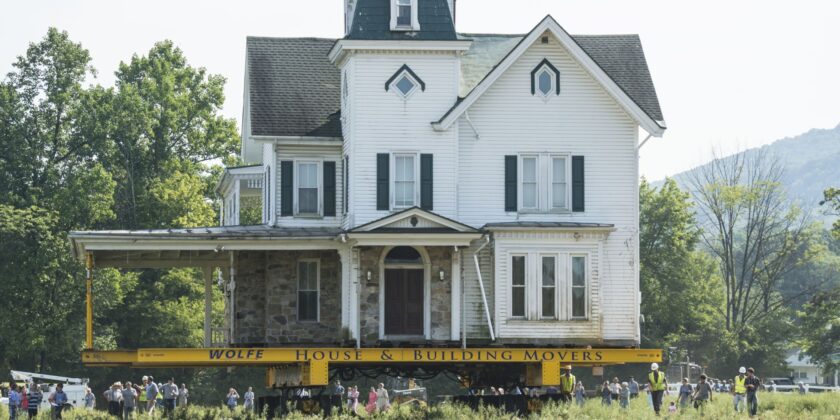
Historic building preservation doesn’t always mean keeping an old house exactly where it has stood for generations. Sometimes, the best way to save an important building is to move it. Private homes can be candidates for historic relocation when the structure has architectural or community value and circumstances make staying in its original location impractical. The relocation of the Victorian-era mansion near Newmanstown, Pennsylvania, is a remarkable example of how an old home can receive a second chance rather than face demolition.
When Does it Make Sense to Move a Private Home?
Moving a house is obviously not the first choice for most homeowners. It’s a major undertaking that requires careful planning, engineering, permitting, and a suitable destination. Still, age alone isn’t what determines whether a home can be moved.
A private residence may be considered for relocation when it has distinctive architecture, a meaningful history, or strong ties to the surrounding community. The condition of the structure matters, too. A house needs to be sound enough to withstand the stresses involved in lifting and transporting it.
The property also needs a viable new location. There must be enough room to get the structure out of its existing setting, travel the planned route, and position it safely on a prepared foundation. Utilities, roads, bridges, trees, fences, grades, and other obstacles all become part of the planning process. That was the situation with a historic mansion in Lebanon County.
The Newmanstown Victorian Mansion
Known locally as “The Mansion” or the Arrowhead Springs Mansion, the house dates to approximately 1792 and has been part of the Newmanstown-area community for more than two centuries. The large home included five bedrooms and four fireplaces and stood on a property of more than 300 acres associated with Arrowhead Springs.
Nestlé Waters eventually owned the property. By that point, the mansion had spent years with very limited occupancy and was no longer being used as a family residence. Demolition was a real possibility. Instead, the company decided to look for a way to preserve the house.
Paul Brubaker, a nearby resident, purchased two acres from Nestlé Waters, with the mansion included as part of the arrangement. The deal provided an unusual opportunity: rather than tear down the old house, it could be moved onto Brubaker’s property. The idea became personal for Brubaker’s family. His daughter, Sarah Martin, had seen the house and wanted to know what would happen to it. She and her husband, Rick, loved older homes and decided to make the mansion their home. Brubaker handled the arrangements for the move and began looking into what would be required to relocate such a massive structure.
Bringing in Wolfe House & Building Movers
Wolfe House & Building Movers was the best choice for this historic building preservation through relocation. The company specializes in moving houses and other heavy structures, making it a natural fit for a project that was beyond the scope of an ordinary residential move. The mansion had to travel roughly a quarter mile from its original property on West Bethany Road to its new location on Stricklerstown Road. Although the distance sounds short, moving a historic house that weighs hundreds of tons is anything but simple.
The Wolfe House Movers crew prepared the building by installing a framework of heavy steel beams underneath it. Structural moving dollies designed to carry buildings were then fastened under the steel. The house and steel framework weighed approximately 235 tons. The dollies provided the lifting and rolling capability, while a computerized steering system allowed the crew to carefully control the direction of the house.
Giving an Old Home a New Future Through Historic Building Preservation
The Newmanstown project demonstrates that historic relocation isn’t limited to museums or publicly owned landmarks. A privately owned house can have enough architectural and sentimental importance to justify the effort, particularly when moving it provides a practical alternative to demolition.
The process does require professional evaluation. The home’s construction, structural condition, size, route, destination, and local requirements all have to be considered before a move can be approved and scheduled. It’s also important to understand that moving a historic home isn’t simply a matter of lifting it onto wheels. Every stage needs to be coordinated.
Wolfe House & Building Movers showed what is possible when specialized equipment, experienced crews, and careful planning come together. The mansion’s quarter-mile journey wasn’t just a feat of engineering. It preserved a recognizable piece of the Newmanstown area’s history while giving the house a useful future.
For homeowners and property owners facing a similar situation, relocation can be worth exploring before an irreplaceable structure is lost. In some cases, historic building preservation may not mean leaving a house where it is. It may mean having the expertise and determination to give that house a new place to stand.